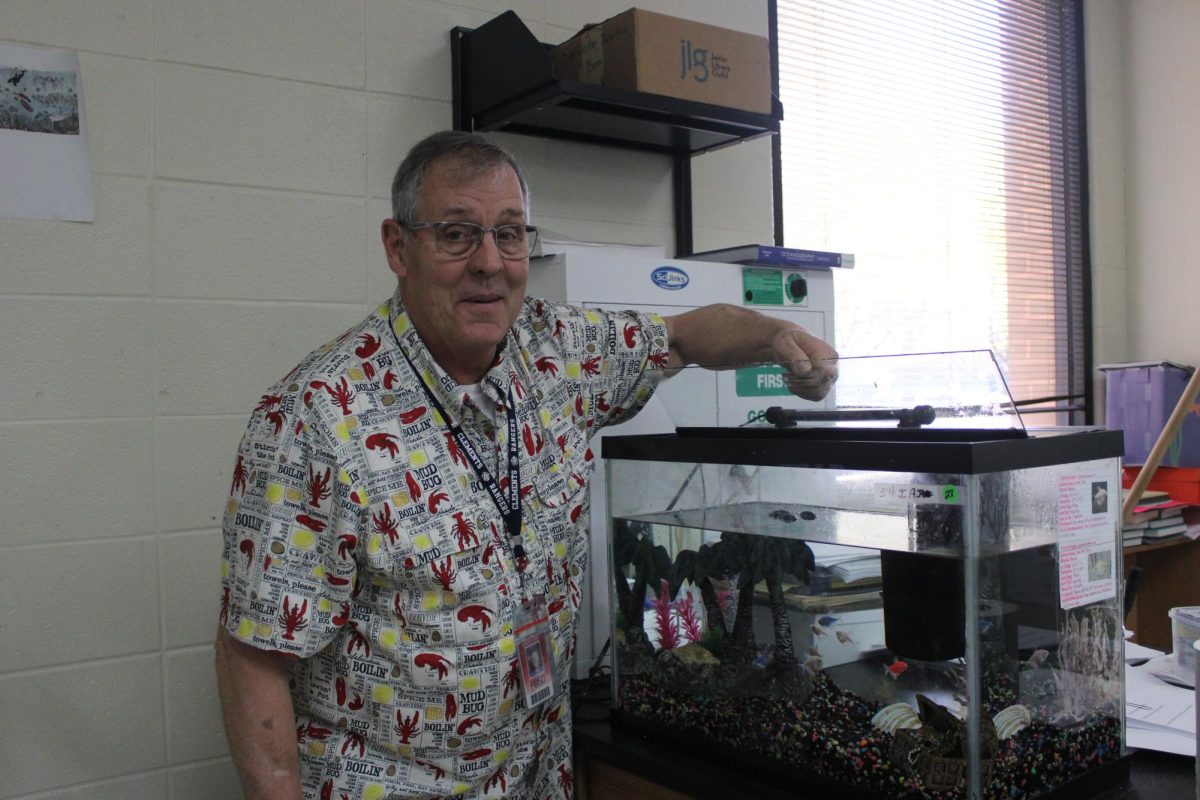


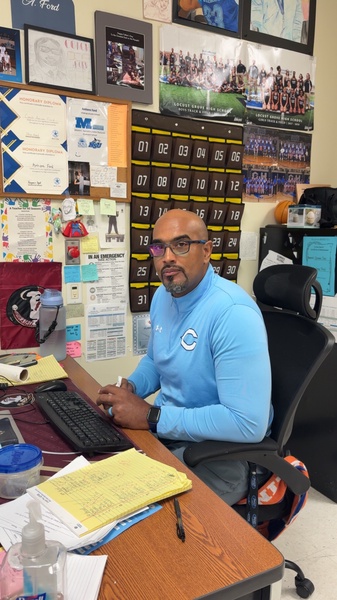
As a child, Coach Antione Ford played basketball using milk crates nailed to telephone poles. Ford was often outside from dawn to dusk, learning the game by watching college basketball and the NBA, then practicing what he learned with other kids and the makeshift hoops.
Ford grew up with very little—raised by a single mother in East St. Louis, IL—and devoted himself to being the best teacher, coach and mentor for his students and players. Back then, he would have never guessed that he would spend the next 21 years also teaching biology.
“Me and my mother and my little brother lived in a predominantly white neighborhood,” Ford said. “I dealt with some serious racism, and some serious bullying at the age of 14, [from] 18 to 22-year-old white men that were trying to physically harm me.”
Because of the bullying, in ninth grade Ford moved to Cahokia Heights, IL, and attended a different school where he met a biology teacher named Mrs. Vincent who consistently showed love and genuine care to all of her students.
“I met some really good, genuine folks that changed my perspective and kept me from being racist,” Ford said. “And I’m glad because that experience itself opened me up to be able to communicate and relate with people from all over the world, which I’ve had the pleasure of doing.”
His former student, Zainab Abbas said that he always tells his students to always be kind to others and to look for the good in people and their intentions.
“God led me to teaching,” Ford said. “He closed every other door but the doors to education.”
Ford is currently in his sixth year as a teacher in Texas, after spending 15 years teaching in Georgia. Ford was the first for many things in his family: first to graduate from college, first to earn a master’s degree and first to play a college sport, basketball. He got recruited in college by his coach, Coach Littrell, who he saw as a “father figure” and has been a huge influence on him.
“Coming out of college, I didn’t immediately start teaching,” Ford said. “I actually took an internship with the Illinois state government working on Senate Democratic appropriation staff. And I found out I didn’t like politics either.”
When Ford moved to Georgia, he was on the verge of enrolling at Georgia State in their physical therapy school but ended up teaching at Bethune Middle School in Decatur instead. Ford did not coach his first two years of teaching. When he started coaching, he did it for free and required only a team, pair of shoes and a jumpsuit. There, his team had a winning season that went two rounds into playoffs one year and one round the next year.
“Then that third year, oh, the team was trash,” Ford said. “We were terrible and it was frustrating. This is how dedicated I became and I was crazy.”
Ford became an assistant coach at the middle school but also started volunteer coaching at the feeder high school.
“I would leave practice from the middle school at 6 p.m. to go to the high school practice at 6:30,” Ford said. “I wouldn’t get home at night till like 9:30 p.m. at night. And doing this all for an extra $20 a month.”
In his earlier coaching years he was a hothead, Ford said, but his style has gradually changed for the better in the past few years.
“There was one game I didn’t like the referee’s call, and I kicked over the chair on the bench,” Ford said. “But my coaching acumen has grown because of studying and watching.”
But the big push came when Ford and his wife moved to Texas. Observing the sheer number of good coaches pushed him to grow.
“He has been more than a coach to me ever since I came to Clements,” junior Davis Mahalick said. “He always asks how I’m doing and if he feels like something is wrong he asks.”
Coach Kanika Harvey, who is currently in her third year coaching with him, said he has never gotten out of character. He puts extra effort to be extra early on practice and game days. Even on weekends he would spend his time developing plays by watching game films.
“He cares about the players’ development outside of basketball the most, however, he does so in a way where winning is also prioritized,” Mahalick said.
Biology teacher Joshua Cahal, who has known Ford for the past three years, said he has definitely heard his coaching style while teaching.
“He talks like a coach,” Cahal said. “He’s very loud. You’ll see him get up in his student’s business. But in the friendliest way possible. I think he epitomizes that best combination of teacher and coach.”
Outside of class, Cahal said he is basically the “same friendly, loud, engaging guy.” He might joke around and talk smack here and there but otherwise, it’s the same person. Abbas said he’s one of the teachers that actually wants to be there, 100% of the time.
“The way he teaches, he always makes sure everyone is paying attention,” Abbas said. “He makes the lessons interesting.”
For Ford, the most rewarding part of his career isn’t in wins or titles, but in the growth of his students and players. He said there isn’t just one moment but rather “a series of moments,” watching students mature, gain confidence and overcome challenges. From seeing grades improve to helping students in difficult situations, whether it is school work or mental health issues, Ford is there for his students, making an impact beyond the classroom and the court.
“It’s just a collection of impacting and touching lives,” Ford said.