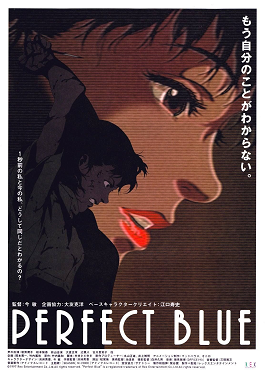
“Perfect Blue” was a movie I found out about through pure curiosity. Between 2022 and 2023, I was very active on Pinterest around Halloween time, and I began seeing girls doing “Perfect Blue” costumes. It was a pop-idol outfit, consisting of a short red dress with a sweetheart neckline, long white gloves and a red hairband. Now, the outfit itself wasn’t very outlandish, but what drew me to it was the blood splatters on the face and dress and the side-by-side photos from the movie. I later found out that the outfit belonged to the main character, Mima, toward the end of the movie. And boy, did it hold significance.
Back then, any and all questions I had about the movie were met with, “…Just watch it, and you’ll see for yourself.” So, I got too curious and watched it around the beginning of this year. The movie follows the main singer in the pop group, “CHAM”, Mima Kirigoe, and her desire to transition from being a pop-idol to a movie star. But things don’t go her way. Instead, Mima ends up in a series of situations that lead to her into what can only be described as psychosis, rooted in debilitating anxiety. The main catalyst is her delusional stalker, Mr. Me-Mania, a creepy man who made an entire website called “Mima’s Diary,” posing as Mima and journaling very personal, intrusive entries on her daily life. The man has a deeply unhealthy obsession with her, specifically the picture-perfect, innocent pop-idol perception of her in his mind. When she strayed from this persona, it sent him into an angry frenzy. He would routinely stalk her every move; wherever she went, he was there, watching her from afar. This would escalate later on in the story to him attacking her violently, punishing her because she no longer fit the idealistic picture of her he had painted in his head. Alongside this deranged man follows Mima’s manager and friend, Rumi Hidaka, the unsuspecting wolf in sheep’s clothing. Throughout the movie, Rumi is a relatively ordinary character, often acting as a sort of big sister to Mima in the way she expresses concern for her when she’s put in uncomfortable positions. Rumi used to be a big pop idol herself, so she knew the industry well and wanted to guide Mima. At least, that’s how it seemed. I remember watching “Perfect Blue” for the first time and being completely blindsided when it revealed Rumi to be an obsessive antagonist. I, for the life of me, couldn’t understand why she would want to kill Mima. But around my second watchthrough, I realized that there were subtle signs each time she appeared. Rumi’s previous life as a pop idol heavily influenced her choice to be Mima’s manager. But Rumi was “past her prime” in terms of age, since the industry focuses heavily on idols being youthful and fresh. So, as Mima’s manager, she’s able to live vicariously through Mima’s stardom, growing resentful when Mima leaves the idol group. Rumi is very insistent on Mima staying in the pop-sphere, a clear sign of how she projected herself onto Mima. Realizing all this, it made so much more sense why Rumi adopts Mima’s pop-persona and seeks to kill her as a way of replacing her, as retribution for Mima’s desire to be a “dirty actress” instead of an “innocent idol.”
There is a lot to unpack in this movie, symbolism-wise. My main takeaway was that “Perfect Blue” is meant to be a criticism of the entertainment industry. It’s a critique of how society places pop idols on pedestals, encouraging people to form parasocial attachments to them. The most modern example of this would be K-pop idols and the concerning idolatry some fans feel towards their favorites. This can often involve an obsessive need to know everything about the idol, death threats and, yes, even stalking. It is deeply unhealthy and harmful for idols, yet some exploitative agencies feed into this, seeing it as an opportunity to make more of a money, since these fans will buy just about anything put out by their idols. “Perfect Blue” displays this behaviour in a beautifully haunting tale of obsession. Mima’s stalker becomes obsessed not with her but with what she exudes as an idol: innocence, beauty and liveliness. He becomes dangerously infatuated with her, going so far as trying to assault her as a twisted form of avenging the pop-idol persona she so “selfishly” left behind. Alongside this comes the more inconspicuous criticism of the industry’s emphasis on youth and how women “lose their value” as they age. This one isn’t as talked about as the parasocial aspect (mainly because it’s not the focal point of the movie), but we can see brief instances of it in how Rumi behaves with Mima and how Mima is treated within the industry. Rumi lost her value as an idol the second she started aging, no longer viable in the industry’s eyes. They want young, beautiful girls that are appealing to the eye and utterly naive. Powerful people take that purity and destroy it, exploiting young, conventionally attractive girls’ bodies. This is paralleled when Mima is asked to partake in explicit photoshoots and a controversial scene in “Double Bind,” her first movie upon her transition into the film industry. The scenes are uncomfortable and visceral, highlighting how the film forces you to confront the ugly side of the entertainment industry and human nature up close.
Overall, “Perfect Blue” exceeded my expectations. It was definitely weird and a little hard to understand the first time I watched it. That was mainly because there are many aspects of the movie that make people question whether it was real or just a fictitious figment of Mima’s deteriorating mental state. It can be frustrating to decipher, but that’s what’s so beautiful about the movie. There is a great deal that’s left up for the viewer to interpret. But more than its entertainment factor is how it also serves as an important social critique on the treatment of women in the entertainment industry through an unconventional and extreme reimagining.