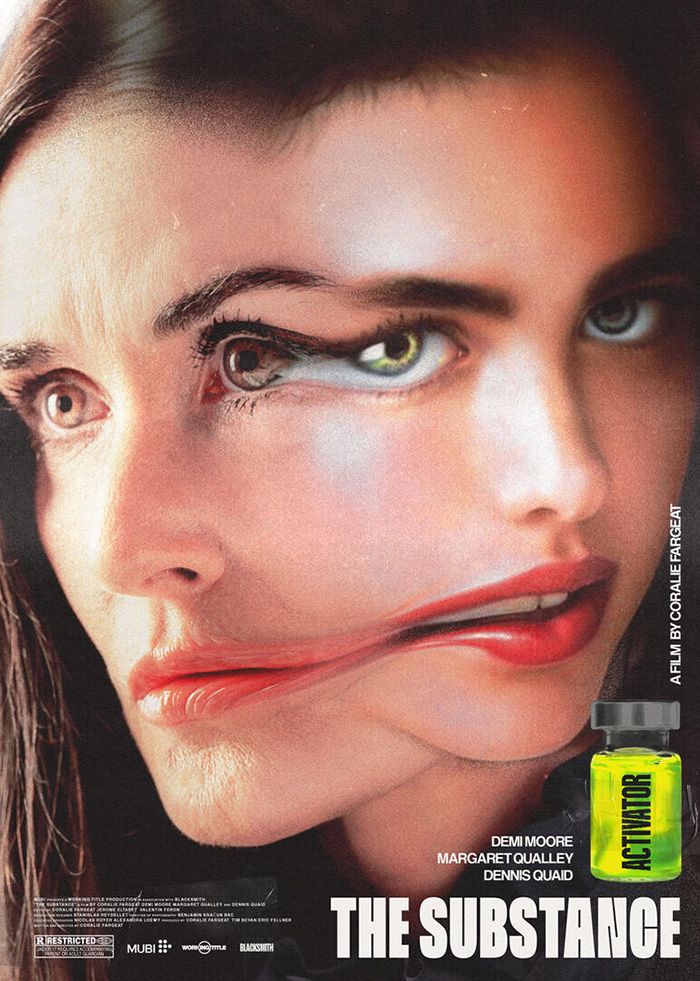
Watching “The Substance” felt like a fever dream designed by someone who hates Hollywood, loves body horror and decided to make that everyone’s problem; this is a good thing.
The premise sounds almost absurd: Elisabeth Sparkle, a once-famous TV fitness star, is losing the fame she once had because she’s aging, so she takes a mysterious drug that literally creates a younger version of herself. Problem solved, right? Well… not quite. The drug produces Sue, a younger body that Elisabeth must switch with every week. What starts as a “cheat code” for youth quickly becomes a full-blown nightmare.
But what makes this movie actually interesting isn’t just the grotesque transformations or the shocking visuals (which, fair warning, are wild). It’s the way the film turns Hollywood’s obsession with youth and beauty into literal body horror.
Hollywood, But Make It a Horror Movie
The movie basically asks: What if Hollywood’s treatment of women was shown exactly as ugly as it really is?
Elisabeth is dumped from her job not because she’s bad at it, but because she’s losing her vitality. Her replacement, Sue, is instantly adored; not because she’s more talented, but because she represents what the industry thinks audiences want: a young, vivacious, beautiful face with an innocent yet undoubtably sultry allure; it’s a trope constantly utilized in Hollywood for engagement.
The film exaggerates the way women are filmed and looked at. The camera constantly zooms in on body parts (legs, lips, hair) in ways that feel almost ridiculous. That’s intentional. The movie is basically mocking the “male gaze,” where women are framed as objects meant to be admired rather than people with agency. The deliberate exaggeration emphasizes the thinly-veiled objectification that other movies depend on.
At times it feels like the movie is saying: Oh, you want perfection? Here’s perfection. And then five minutes later it introduces a visual that completely destroys that idea in the most horrifying way possible.
The Symbolism of “The Substance”
On the surface, it’s a miracle product that gives Elisabeth the perfect younger body. But metaphorically, it represents society’s obsession with self-improvement and perfection, especially for women in entertainment. It promises control, confidence, beauty and attention. The problem? You can never actually stop using it. It becomes an addiction.
Once Elisabeth starts relying on the substance, it becomes addictive and destructive. Instead of fixing her life, it traps her in a cycle where she sacrifices more and more of herself just to maintain the illusion of perfection. She, the matrix, deteriorates before our eyes, as Sue maintains her “perfect” image.
In other words, the drug is basically the physical embodiment of the beauty industry. They start using it because they think it will make things better. Then they realize they can’t live without it. Then it destroys them.
Not exactly the skincare routine Hollywood advertises.
Elisabeth vs. Sue: The War With Yourself
The relationship between Elisabeth and Sue is probably the most unsettling part of the movie. They are the same person, but they start seeing each other like rivals.
Sue represents everything society values: youth, confidence and attractiveness. Elisabeth represents what happens when that value disappears. The more successful Sue becomes, the more Elisabeth crumbles, physically and emotionally. It’s basically the most extreme version of comparing your current self to your younger self. And the movie takes that insecurity and turns it into a literal monster.
“The Substance” is not a comfortable movie (please don’t watch this if you’re queasy). It’s gross, chaotic and sometimes so intense you don’t know whether to laugh or look away. But underneath all the insanity, it’s actually a really sharp critique of Hollywood’s obsession with youth and the impossible standards placed on women. It’s like the director is yelling in your face that the glamorized pictures you see on screen are not a realistic portrayal of reality. Aging isn’t ugly; it’s normal and inevitable.
The film basically says: if society only values women when they’re young and perfect, then of course people will try to become something artificial. It perfectly describes the unsettling influx of women getting excessive filters and abusing substances like Ozempic. It’s very easy to compare those drugs to the “substance’’ as advertised in the movie; both fuel a warped sense of self, one that affects both the person using it and the people who look up to said person.