With the commencement of the 2025-26 school year all choir students are required to complete solo sightreading in front of the class. Choir directors Justin Shen and Jade Blakey hope that this new addition improves student confidence. Students have mixed reviews.
“Part of our coursework is to become performers,” Blakey said. “Performing as a group is definitely one of my favorite parts about choir, but in building your personal confidence, that’s getting to know your own voice. You never hear your own voice when you sing together.”
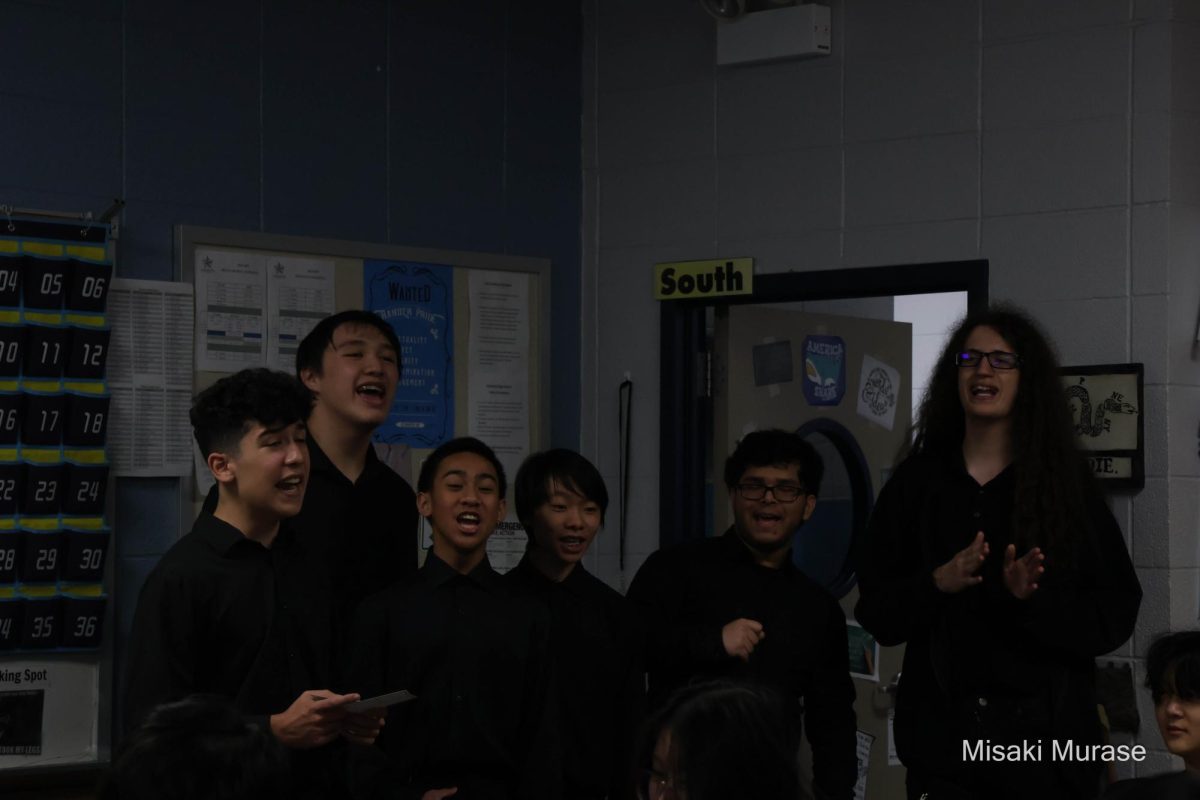
Sightreading is a process used in audition and class settings to test an individual’s ability to sing the rhythm and pitch of a brand new exercise musically and accurately. This year, students gained access to Sightreading Factory, a website where they can practice exercises based on the required levels. During class, they can either volunteer to go or are called on at random. Each student has around 10-15 seconds to practice the four-measure piece before performing it to the class. If the student passes on the first try, they receive a sticker. If the student fails, they have to try again on a different day.
“[Sightreading] is fun, and I’m passionate about singing,” senior Joshua Yuan said. “Plus, sight reading in front of the class isn’t a competition but always a learning opportunity. At Clements, we have a really great support system in the choir. I can say that in Chorale, our directors and students have always worked together to uplift each and every student.”
Sightreading in front of the class has many positives. It has the potential to build individual confidence, decrease anxiety, increase the students’ musical abilities and create a stronger community across the entire choir.
“I like to think of it like training for a fighting style,” Yuan said. “For putting yourself out there, it strikes your confidence. When you’re done after, it’s just like ‘Hey, that wasn’t so bad.’ You think about it and are encouraged to do it again.”
However, it also has the potential to destroy individual confidence, increase anxiety and create a toxic environment among the classes.
“In a way, it’s scary to make mistakes in each level in front of such a big class,” senior Shruthi Gaduam said. “That tends to make you feel nervous of your environment because you don’t know everyone personally and how their authentic reactions would be.”
Sightreading is similar to public speaking for choir. There is the potential to improve the skill, but at the cost of judgment, especially in a talent field.
“I’ve noticed that when my friends go, some people make comments and say rude things,” freshman Audrey Ma said. “I think it’s rude because when they are up there, we aren’t being rude like them.”
In each individual choir, there is a varied amount of musical knowledge that each student has, causing a disparity in which levels each student is on. This difference in skill often leads to students feeling that they are being judged by their peers.
“People are judging my singing abilities and my position in the class because of mistakes that I made in front of the varsity choir,” senior Ayra Majid said. “That makes me anxious when singing around people in choir and lowers my confidence.”
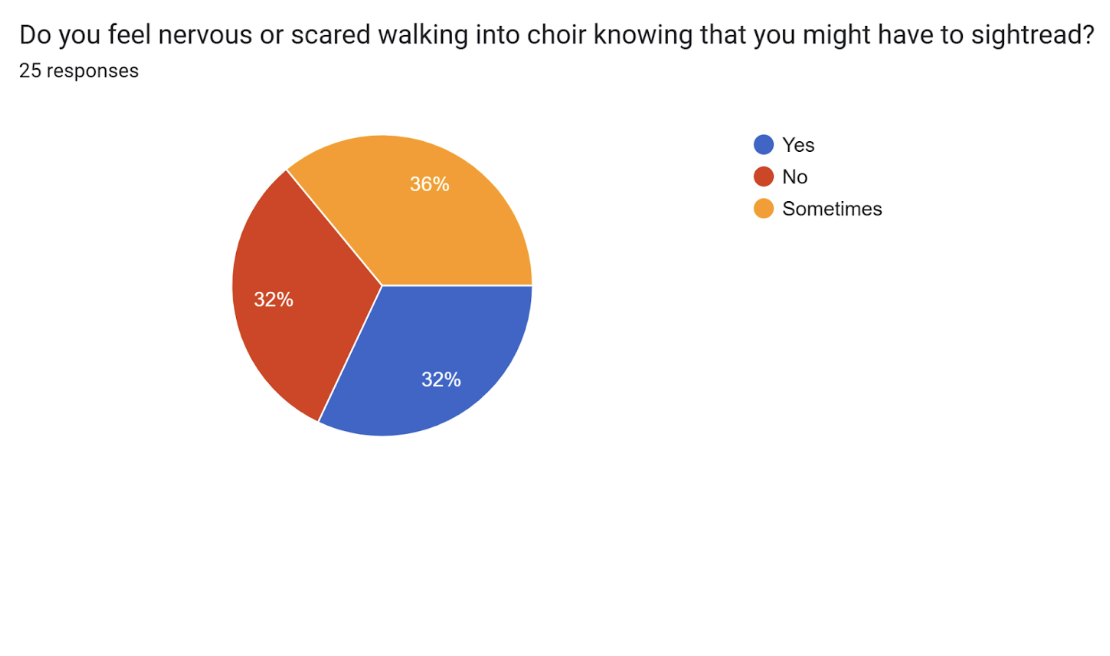
A student survey was conducted on this topic to gauge student opinions. Out of 25 students, 36% of the respondents stated that they sometimes feel nervous when walking into the choir room, while the rest had an equal split between yes and no. When asked if sightreading lowers anxiety, 60% of the respondents said no. However, when asked if the task increases their confidence, 56% of the respondents said it boosts their confidence.
“Having everybody as a support system around me is really helpful, especially because of how kind and cheerful they are,” senior Noel Shadid said.
When interviewed, Blakey acknowledged both the pros and cons.
“I don’t want choir to be a source of anxiety, which is why we have removed the grade component from the performance aspect,” Blakey said.
However, she also said that she believes it isn’t fair to only assess students once a year. She shared that one of the goals for the year is to improve individual strengths and constructive feedback, meaning there has to be some type of individual performance.
“I know that it might scare off kids, like I was probably one of them,” Blakey said. “If I had to sing in front of my class, I don’t know if I would have made it all the way through.”
Every year, choir struggles with retention and gaining enough students to qualify for two directors. The current sightreading program may affect the number of members.
“The recruitment numbers might suck, but the retention, I’m hoping, will go up, because students are getting better feedback,” Blakey said.
Regardless of the mixed opinions, there is no known change to the current process foreseen in the future. Being that this is a new program, there is insufficient data to assess what the outcome of implementing it will be. Only time will tell if this is a fleeting experience or staying forever.
“For those students who are frustrated that they don’t see a change in the process, I invite them to share solutions,” Blakey said. “I also see the problems, but I don’t have a ready solution, and I need to see more [ideas].”