


A room with no doors.
No mirrors.
No exit.
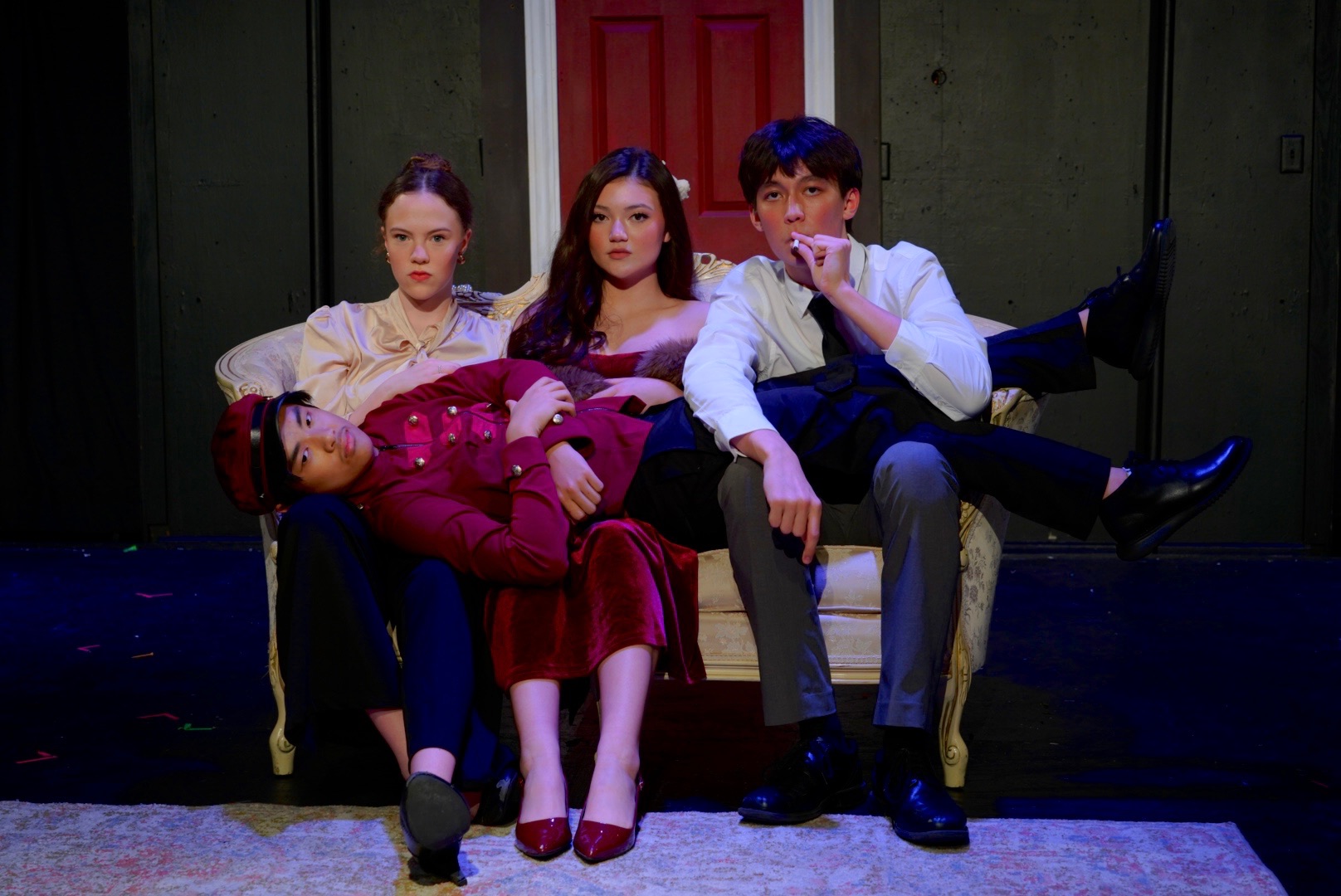
Just a suffocating chamber where the air hangs thin, as if holding its breath for the next three strangers about to enter. When the lights dim and fog crawls across the floor, they understand the truth behind their imprisonment, there are no flames, no chains, no daggers waiting to start a torture session. Only each other, serving as a hell that they cannot escape.
This charged atmosphere was exactly what senior Aanya Chand wanted to create in her student directed one act play, “No Exit.” This is an existential play written by philosopher Jean-Paul Sartre and unlike the other four student productions that were centred around comedy and entertainment, “No Exit” explores themes of guilt, insecurity and the damaging ways people affect one another.
“The three characters just died, and they have this bellboy that walks them into the room one by one. Then he just leaves, and it’s just three people in a room, and they’re told it’s hell,” Chand said. “The whole premise of the play is that you don’t need any physical torture, you don’t need anything else. If you just pick the right people and put them together, they become hell for each other.”
These student-directed, one-act plays, known within the theater department as SDOAPs, are led by seniors in the varsity theater productions class, with minimal interference from theater teacher Gavin Mundy. Students pitch productions through presentations and essays in class, write a screenplay, then pick their cast through actor auditions.
“We have a project where we create a pitch, like in Shark Tank,” Chand said. “Everyone has to do it, regardless of the grade you’re in, but only seniors are considered for having a show. Mr. Mundy will listen to you and decide whether your show sounds good, whether we have the facilities to do it, whether he can trust you with working with a bunch of kids, and then you will get the place.”
For Chand, directing this play had been a dream for years.
“Ever since I read the play ‘No Exit’ in sophomore year I’ve known that I wanted to do it,” Chand said. “The class I’m in right now, I only auditioned to be in this class so I could have my own play. This was like my big end goal. So that’s why I’ve always wanted to do this. And then as soon as we started I got all of the actors I wanted, and everything was falling into place. I just really wanted it to be the best.”
The play follows three strangers, Cradeau, Inez and Estelle, trapped in hell where they slowly uncover one another’s sins while realizing that they themselves are the punishment.
“You have Cradeau who is a coward and because he doesn’t want to be a coward, he does these horrible, horrible things,” Chand said. “Then there’s Estelle played by Layla who is this pretty, ditzy girl and she killed her baby. She wants all the vain things in life. Then you have Inez played by Jillian who is the rude lesbian. She wants something that she can’t really have in that dying period and she does horrible things to get that. Her problems came with the situation, because you can’t be a lesbian in 1940.”
Junior Dylan Gage who played Vincent Cradeau said the show differed greatly from the theatrical productions he has done before.
“There’s no real plot to ‘No Exit,’” Gage said. “It’s honestly a very boring thing to read. I feel like the humor comes from the absurdity of the situation and the audience more thinking themselves about their interpretation of the play, rather than a comedy or a farce where it’s just the characters’ relations. It’s very different and it’s much harder to do. It’s more exposition than normal.”
Sophomore Layla Nichols, who played Estelle, said that the small cast created even more pressure for the actors, who always had to be focused during the play. However, the decisions in the play were not made alone by director Chand. The actors also had a lot of creative control in the entire process.
“You get tunnel-visioned when you’re in the show, because you’re so focused on being this character,” Gage said. “You don’t get to be in the audience and experience everyone trying their best, and then it actually comes together as a product. You only get to really control what you do, and you don’t really pay attention to the others.”
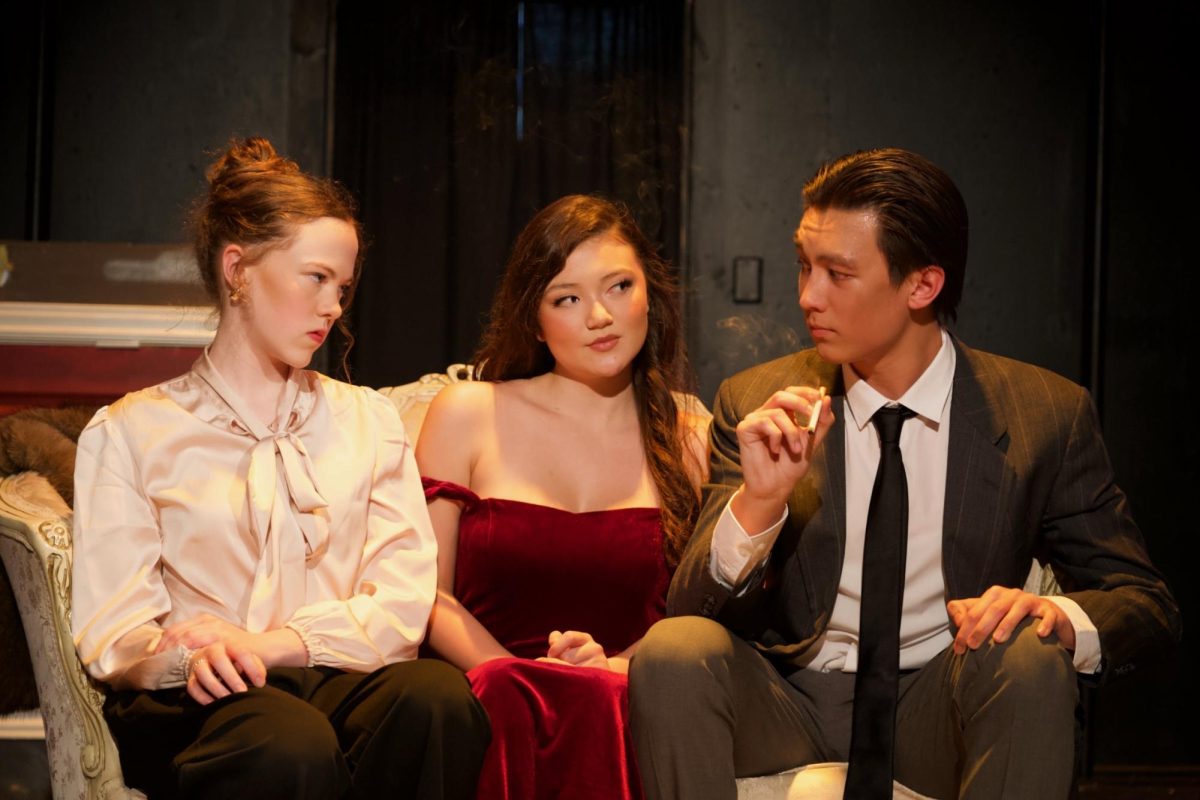
The rehearsal process itself mirrored the intensity of the production. Auditions began immediately after spring break, leaving only a few weeks to prepare before the opening night. The cast often stayed late at school in order to rehearse for the play.
“We rehearsed 3-5 after school, sometimes 6 p.m.,” Chand said. “What was really weird about this show is that we didn’t have a single Saturday where we could rehearse consistently. Because normally if you get a Saturday rehearsal from 9 a.m. to 4 p.m., that’s seven hours to work on the show. Basically you’re doubling the amount of time you would do, but for this show we had almost no Saturday rehearsals.”
Unlike larger productions with full technical crews, Chand also handled many behind-the-scenes responsibilities herself.
“Our booster club gives us a budget and usually we get either no money or we get $100,” Chand said. “We also have costume closets with a bunch of stuff and then the light, sound equipment is all there. We get furniture from the storage we have. I also went to thrift stores and I had to go thrift books and whatever else I needed, I had to personally source it and make sure it was time period accurate.”
Throughout the rehearsal the actors and Chand experimented with costume, dialogue delivery, movement and tone. This helped shape the production into something uniquely their own.
“For me and Jillian, our voices are very high, and so Aanya wanted me to change my voice,” Nichols said. “My voice became a lot higher, and Jillian’s voice became a lot lower. It was really challenging at first to stay in the high voice without sounding too performed, but I think getting into character, just being really, giggly and evil was part of it, and then just finding ways to draw attention to myself because there are a lot of moments where I don’t talk, so just finding things I can do to stay in character and be annoying.”
As performances finally began, the audience reactions became one of the cast’s favorite parts of the experience.
“The audience notices more than I thought they would,” Nichols said. “Jillian, she did something funny with the Mein Kampf, and the audience noticed and laughed. My mom was talking to me about it after, and I was like, ‘Oh, I didn’t even know she did that.’”
Gage said that he may be one of the “worst people to be in theater” because he gets so nervous on stage, but hearing the audience respond with laughter and admiration after weeks of rehearsal made the exhausting process worthwhile.
“I feel like you go through all these trouble, you spend all these rehearsals with no audience,” Gage said. “You’re going over your lines for such a long time, and once you finally have an audience who can appreciate the work, that’s the best feeling in the world. Getting a laugh from the audience is the best feeling ever.”
Junior Patrick Mallory who was in the audience said that the production was easy to follow, and it stood out because it mixes humor with serious themes in a way many plays do not.
“At the start, I thought it was very grounded and mysterious and I was very curious of what was going to happen at the end, even though it ended up just being they’re just stuck there,” Mallory said. “Everyone was very distinct. They had their own character. They did a lot of switches throughout, like, with Cradeau and Estelle. I think it ended up being very believable. And Inez was just crazy, which I think worked out.”
Although “No Exit” ends with its characters trapped together forever, Chand hopes that the audience would leave the theater carrying the message of the play with them long after the lights went out and the stage was cleared.
“It’s very serious in bits and very scandalous in bits,” Chand said. “But I think it makes you reassess everything we’re told and how we treat people, because a lot of the conversations are very normal-people conversations, but to them, it’s hell. If we were stuck in a place like that for the rest of eternity, it would be hell for us too. I want the audience to take something away from the show instead of just having a few laughs and then forgetting about it.”