The $220 million new campus—whose construction is progressing without delays—will be finished the 2027-28 school year. It will include larger, windowed classrooms, new common learning spaces, three gyms and improved athletic facilities.
“We had someone come out and study [our building], and they found that our building was in need of a lot of repairs, and the cost of those repairs versus a new building just wasn’t worth,” Assistant Principal Kevin Byrd said. “Might as well go ahead and get a new building to get moving forward for the next 40-50 years.”
Besides, the building is actively sinking with visible cracks along the floor and walls.
“The building principles on this type of soil were different [back then],” Byrd said. “The depth of the piers in the new building and the amount of piers vastly outnumber what’s in this building, so it helps lock everything in to make it more structurally sound and supported.”
While the current campus remains safe, Byrd said it would not last another 40-50 years sinking the way it currently is. Principal Tara Baker believes that the new campus will inspire a wave of excitement for the students with its myriad new and improved amenities.
“We’re going to go from a 1983 old building to a 2027 building,” Baker said. “We’re hoping that we can take the traditions and the culture that we’ve already built here at what will be the ‘old school’ and bring it to the new building.”
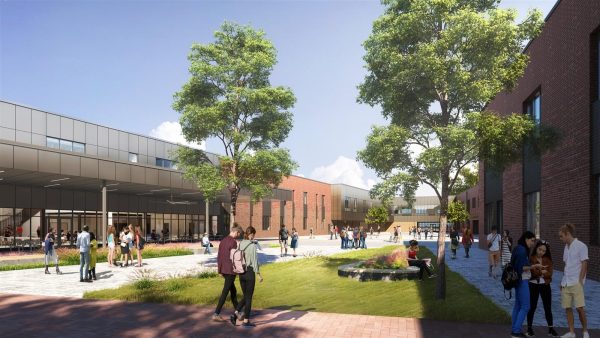
There will be a new pick up and drop off loop, meant to ease the flow of traffic. The biggest change, however, will take place in the main hallway, which will serve as the spinal cord and courtyard of the new building.
“We won’t have one solid structure like this,” Byrd said. “It’ll be, like, wings. And instead of the middle being covered by roof, it’s [covered with glass] all the way from the band hall to the athletics area. You’d be able to walk through there during the day if you wanted to.”
Classrooms will be slightly larger and contain trapezoid-shaped desks with unattached chairs that will be more accommodating for group work.
“We’ve been to trainings at Crawford, which our school is similar to but different in layout,” Byrd said. “But the rooms are the same…It’s just fresh. The lights are different. It’s not dim in certain places. It’s all new and shiny. It’s exciting. It makes you feel good.”
Unlike Crawford, however, Clements is not starting from scratch. The current campus, which students still reside and take classes on, cannot be demolished—until the competition of the new campus—meaning that two campuses exist in the space that of what should be a single campus, bringing certain growing pains.
“Last year, whenever they first put up the construction fence and we had to tell our students that we were going to lose parking, which could directly impact our juniors at the time, it was a big deal,” Baker said. “But I think now that the reality of the situation has set in, and they see, like, this is where we’re going, it just seems like the community has given more grace to those conversations.”
There are no anticipated delays. All of the underground piers are in place, slab laid and the last of the steel beams were erected early December.
“They’re already on the other end of the building working on putting in the internal infrastructure and finishing up the plumbing and the electricity and starting to put up walls,” Byrd said. “They’re committed.”
Academics:
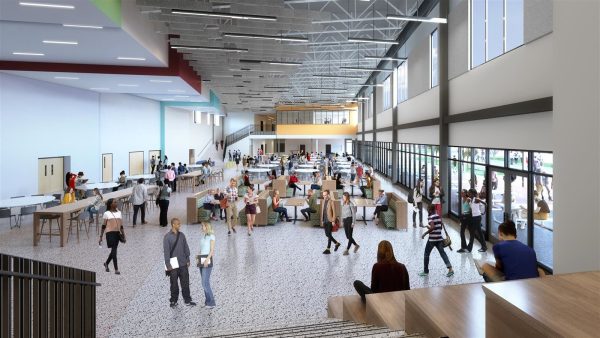
While congestion during passing periods will still be an issue, Byrd said, each wing will have a dedicated stairwell. The “wing” lineup consists of the fine arts wing, an athletics wing, the usual four academic wings and the addition of a Career and Technical Education (CTE) wing. The brand-new CTE wing will include the finance, animal science, biomedical sciences, engineering, JROTC, communications and computer science courses.
“It’s nice because all the other departments get to be near each other, and it’ll be great to kind of have our own little area where we can collaborate,” marketing and business teacher Gregory Eppes said.
Historically, CTE classes have been scattered around the school or held off campus at the Reese Center. But the CTE program on campus is growing. At the start of the year, health science teacher Staci Mikeska moved onto campus from the Reese Center, citing increased student interest. She said she is excited to involve herself in campus culture and participate in spirit days. On the other hand, Eppes—who has taught here for 16 years and spent another four here back when he was a high school student—is looking forward to spring cleaning.
“Clements is what I’m close to,” Eppes said. “I like Clements, and if Clements is on the other side of the parking lot and [is] brand new and big and pretty, that’s Clements to me. So while I know this one will be gone, it doesn’t change it for me. I’m not worried about it going away and having something different.”
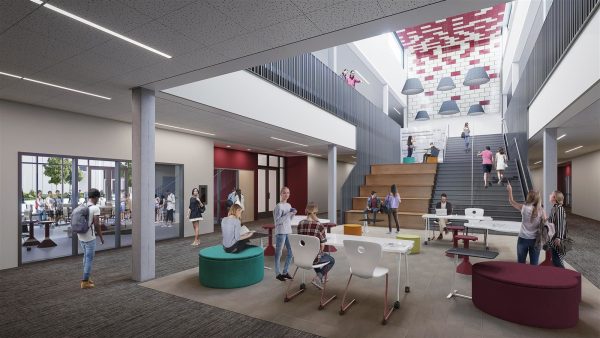
Every wing will also have a common learning space, where teachers can bring different classes together. English teacher Glenys McMennamy believes that the common learning spaces have “a lot of potential” depending on how they are handled.
“It’s going to matter that we coordinate with other teachers in that part of the building so that we’re not trying to inadvertently use the space all at the same time,” McMennamy said. “[It could] be a place where multiple classrooms could go to have people co-teach together.”
Bringing classes together in the common learning spaces could also prove useful in the absence of a teacher. That way, present teachers could bridge the instruction gap instead of settling for asynchronous work.
“The building will become part of the learning space, instead of just the very specific classroom area,” Algebra 2 teacher Michelle Nelson-Archer said. “I’m excited about all the creative things that other people are going to discover.”
Students are excited about the common learning spaces too, like sophomore Hoang Ho, who looks forward utilizing the new spaces to to study with his peers.
“I like the open space and open design of the campus,” Ho said. “It’ll feel more natural. Instead of being enclosed in all these bricks, [it’s more like] being outside and being open to sunlight.”
Spanish 2 teacher Kelliann Flores believes that the common learning spaces will come in especially handy for her classes, seeing how language depends on proficiency. It will be beneficial, she said, for her students to have more people to practice and rotate with. All in all, Flores believes the new campus is a necessary upgrade and hopes, the most, for stable Wi-Fi.
“I’ve been here for seven years,” Flores said. “I started here before the pandemic, and I’ve seen the cracks in this building, and I’ve seen leaks here and there, and I’ve been the APs go crazy and the custodians go crazy fixing things.”
The classrooms will also receive an upgrade, increasing in size with new furniture. The new trapezoidal desks allow for more group configurations, Nelson-Archer said, while maintaining cohesiveness. There will also be a window in every classroom; currently, the science labs are the only classrooms with windows.
“That’s going to be quite a bit different than our current caves that we’re in,” Byrd said. “It’s going to bring in a lot more exterior light to things, which helps…as far as electricity [goes]. You don’t have to have the lights on as much. I mean, there’s a whole big piece of this environmentally that was studied and put into the building.”
More windows will alleviate the sometimes closed-in feel of the current campus, Nelson-Archer said. That, doubled with the wider hallways and more inviting classrooms, helps to promote openness and calmness, she said, which will hopefully improve student mental health.
“Because the kids can move around individually with their chairs, it’s going to be more comfortable for them,” Nelson-Archer said. “I think the classroom space, the furniture and the ability of being more flexible in the classroom is going to be amazing.”
The cramped desks and chairs have been a common grievance among students. Senior Sophia Qi said that she finds it difficult to sit upright while writing.
“I have to adjust my posture to reach the table,” Qi said. “Or if I’m trying to sleep in class, it’s also uncomfortable.”
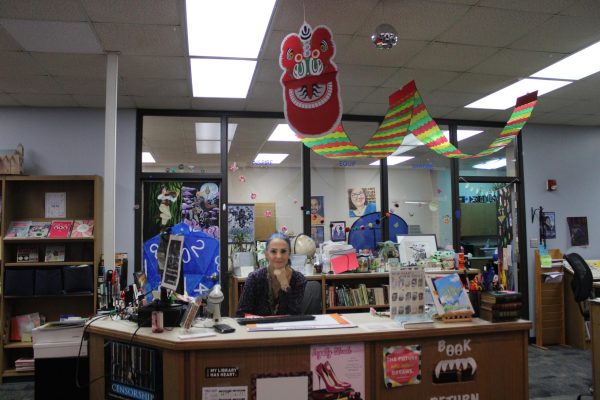
There will also be a makerspace room located just beside the library. The library serves as a bridge between two wings of the building, paralleled by a narrow walkway. Unlike the current library, it will sit on the second floor and is only one story.
“They call it a bowling alley at Crawford, because it’s just a single aisle,” Librarian Marion Brennan said. “There [is] a low ceiling, and it seems to me kind of dark, so we’re going to have to work to brighten it up.”
The library is also substantially smaller, which may prove difficult in terms of fitting all the books from the current library. Brennan said that they’re going to have to make it work and also plans to bring some decorations from the current library for memory’s sake—most notably, the giant star that overlooks the library, measuring 3 feet from arm to arm.
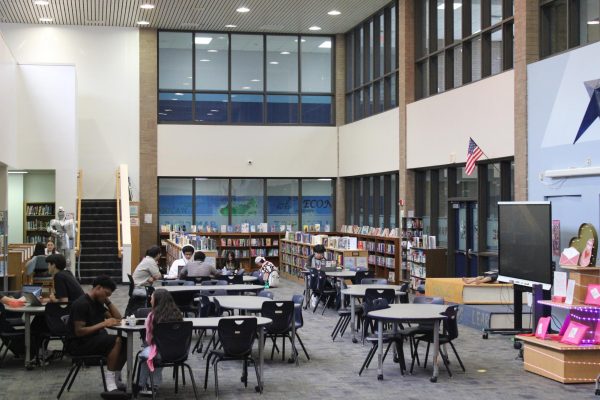
“It was at Austin High School, and it was just a piece of rust,” Brennan said. “I said, ‘Don’t throw that out,’ and it took me…three months to get it delivered. Then when I got it delivered, I had to order the spray paint, and then I wound up changing my mind about the blues, because the blues weren’t working because of the rust color.”
In the end, Brennan managed to find a working blue that covered up the rust. The tedious process to get it where it is now, mounted two stories up as the library’s centerpiece, is a big part of why Brennan plans to bring it to the new library.
“You may see some blue mulch outside where I might have missed with the spray paint,” Brennan said.
Athletics:
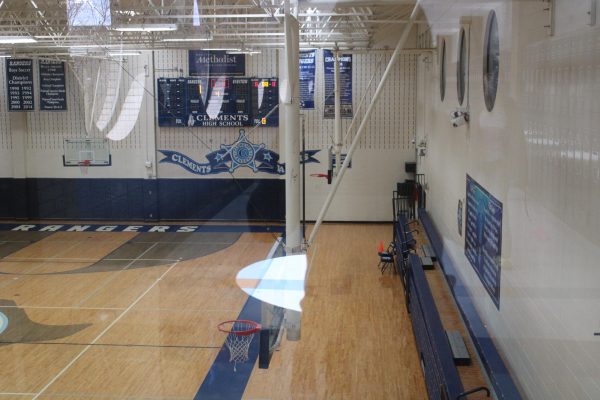
A new gym will also be added, Byrd said, and all of the athletic activity will be held on campus once construction wraps up.
“One will be like a practice gym for color guard, ROTC, dance, and then we’ll have two game gyms,” Byrd said. “We’ll actually have a gym that has bleachers on both sides of the court. That would be our competition gym.”
Chief Jason Gorsuch, who teaches JROTC and served in the Navy for 20 years, said that while the gym situation not yet a perfect scenario, it is an improvement.
“It’s a lot more convenient to have the ability to practice indoors, because it allows us to get inside from the elements,” Gorsuch said. “It allows us to actually practice in an environment that is very similar to some of the locations for our drill meets.”
However, it’s not quite enough considering how there are three drills teams that each need practice areas measuring 85 feet by 75 feet, Gorsuch said—which is about the size of a basketball floor—every Tuesday and Thursday for two hours. The spaces are vital, he said, to perfecting and developing their performances for the next drill meet.
“In Area 17, which is the Navy JROTC area we’re a member of, there’s 27 Navy JROTC high schools in that area,” Gorsuch said. “We finished second among them last year, and the year previous to that we were first in the area. This year, we’re striving to be first again, but it’s a level, sustained, superior performance that we strive for every single year and a standard that our cadets are held accountable to.”
While there is not yet a schedule for the third gym, there may also be a possibility of having access to the two other gyms when there are breaks between sports’ seasons, Gorsuch said, though that would only be a temporary solution. All in all, however, Gorsuch is looking forward to the new building because of its specialized facilities for JROTC.
“We’ll be able to train kids on how to actually shoot pellet rifles and stuff like that indoors,” Gorsuch said. “From the design that I’ve seen, it’s a double classroom with a divider in the middle, and the divider will be able to be pushed open via panels, and that will prescribe the distance for us to be able to compete with marksmanship.”
Besides JROTC, there are also several other entities agreeably vying for gym space, including band, cheer and dance.
“I’m excited about not having all the space conflicts,” Cheer Coach Katherine White said. “We’ll have, theoretically, the Commons and the gym…so, scheduling wise, I’m hopeful it’ll be a lot easier.”
The cheer team practices from the start of 7th period until 3:30 every afternoon in the Commons, before ceding the space to color guard, percussion or the band. White said she hopes the additional gym space will allow cheer to practice longer, as it would increase the amount of facilities available.
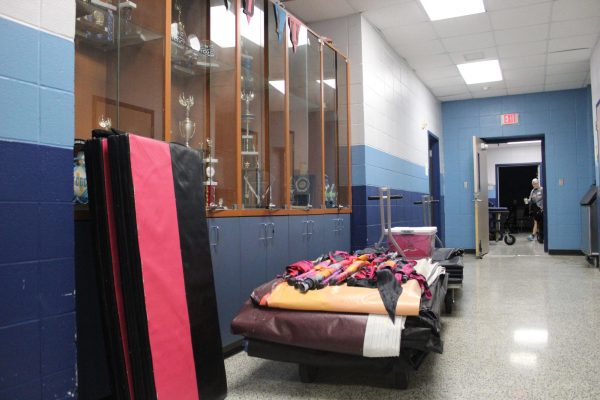
“We literally go to a different space to rehearse almost every day during this time of the year,” Assistant Band Director Leslie Flynn said. “Like this afternoon, we have one [color guard] team rehearsing for two hours, and that’s in the commons today, but on Monday of next week, it’s in the gym. So we change our whole calendar based on the schedule for the day.”
Flynn expects it to be this way even in the new building but is optimistic about communicating and scheduling with the other coaches.
“I like all the people we’re talking about,” Flynn said. “One of the best parts about working here is that we work so well with Ms. Barth and Ms. White and the coaches for JROTC. They’re just awesome.”
To make the most of the space while accommodating three teams, color guard operates on a staggered schedule, Flynn said, practicing until 8 p.m. on the “crazy days” when all three teams are squeezed into a single day, including the middle school “cadet babies.” Generally, though, the schedule is less hectic, and there is always administrative assistant Brianna Russell to dole out who goes where and when.
“We’re just going to continue down the path we’re already on where we all submit what we need, and she figures out where we’re going to go, and we’re all happy go lucky family,” Flynn said. “It’s wonderful, you know. We are very excited to have an actual space that we get to call our own, that we don’t have to kick out a team to use.”
Flynn is also excited about having a dedicated storage space for the portable flooring that color guard performs on and for it to no longer be a “hazard in the hallway.” Currently, they stand vertically in the band hall, just beside the ice machine. Flynn calls their practice situation making a chicken salad with “all the weird ends of the stick,” especially pertaining to the guard room that is essentially a repurposed closet.
“I have 35 kids in the guard room at some points,” Flynn said. “I don’t know how they do it in there. It only fits about 10 people at one time. They manage it, but we’re gonna have a full-on locker room [in the new building]. There’s gonna be sinks and mirrors and everything.”
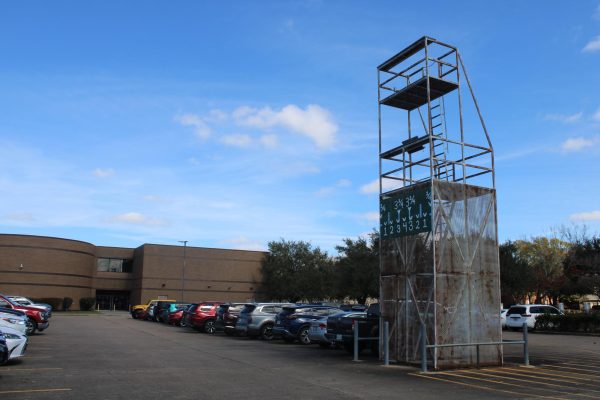
Every fall, color guard joins band in the faculty parking lot. In the new building, band—and by extension color guard when it is merged with band—will receive its own managed lot that will double as the bus ramp. This will minimize car-related disruptions, which hinder the band’s ability to march consistently, Percussion Director Bryan Waites said.
“If you can imagine a football game, if there were a car parked on a football field, how would the football team play the game with a car in the middle of the field?” Waites said. “It’s the same thing for us. When we utilize the field, we utilize the entire field, from goal line to goal line, front to back, sideline to sideline.”
When a car is parked in their practice area, Waites said that staff will usually try the announcements first. Over the years, they have also compiled a list of teacher license plates, so Waites will sometimes send an email or a student to their classroom if they figure out who it is.
“By and large, our staff has kind of learned over the last 30 or 40 years that ‘three o’clock, got to move our car,’ and they’ve done a great job,” Waites said. “It’s the outliers that come, [that] sometimes hinder us for 15 minutes. Sometimes it’s an hour. Sometimes that car never gets moved. We have had to resort sometimes to creative methods of moving the cars ourselves.”
The last case scenario entails attaching a go-jack—essentially a palette-jack for vehicles—to each tire, pumping it to lift the car about two inches off the ground, and then moving the car off the practice area manually.
“We have a team of go-jackers every year, and as you can imagine, the car’s temperature [in] the afternoon, around 3:30, is like 200 degrees, so we have special gloves that the kids wear,” Flynn said. “But it’s very safe to do. [People get] so excited they get their phones out and record, and they think we’re magicians…Dr. Crespo helped move one one time, because he thought it was so cool.”
On the new campus, there won’t be a need for go-jackers, because once the buses leave, there are closable gates that will prevent cars from driving into the band lot. The move will also bring new supplies, including a new platform for the directors.
“Mr. Eppes, his father built this one that we have out here for us years and years ago,” Waites said. “While we’re sad to see that one go—and that has a lot of history and, you know, Mr. Eppes was a Clements band member—we’re excited to bring in some of the new ideas and the new equipment to operate with.”
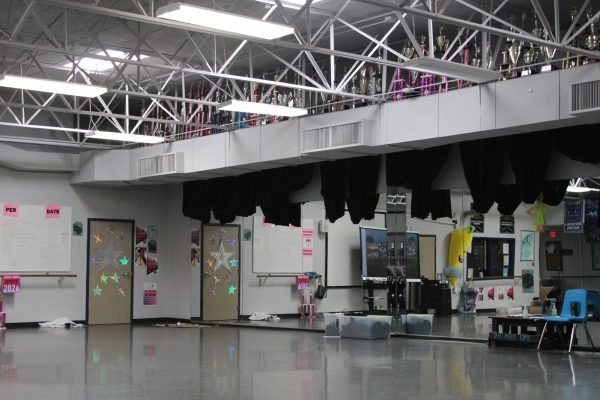
Dance—which uses the parking lot on the band’s off-day, Tuesday—operates under a hectic schedule also, Dance Director Michelle Barth said, especially when contest season swings around. The itinerary varies from master classes to contest choreography, depending on the time of year, but one thing remains constant: their need for gym space.
“It’s monumental,” Barth said. “What’s hard is all of the schools in, for example, Katy ISD, they have dedicated gymnasiums…and it’s somehow organized. And so how that affects us is a big part of our scoring component for competition season is the ability to hit formation with precision on a gymnasium floor.”
This year, the junior varsity dance team has been successful like never before in securing gym space, after its class period swapped from first to fifth period. Dance works around the athletics schedule, taking the gym once athletics retires to lunch.
“The team is more prepared and feels more confident because they have had that time and they have that experience,” Assistant Dance Director Alina Mitchell said.
After school, however, it is much more difficult to secure gym space, Mitchell said, and dance is lucky to be in the gym even once a week. Even then, they “utilized every minute,” she said. In the new campus, she hopes it will be easier with three gyms in circulation, especially considering how the new dance room will be substantially smaller than the current one, originally modeled after Crawford High School’s floor plan.
“I reached out to, at the time, the teacher that was at Crawford and I said, ‘Hey, could you do me a favor and just grab a video of your largest dance class in your space so I can see what that looks like, so I can visualize that many bodies,’” Barth said. “They were barely able to move about the space, and there were 30 kids in her class and it was a square.”
Their largest dance class contains about 50 students, and a traditional dance studio prioritizes length over width. To readjust the shape of the studio into that of a rectangle, dance now sits on the edge of the CTE wing, rather than with fine arts, but size still remains an issue. The dance directors, however, are optimistic about facing and overcoming the challenges.
“We’ve heard the office is really cool for dance, and that we have our own designated locker room, bathroom for dance,” Barth said. “I love that for our students, not just our team members. [It’s] almost like a dance suite.”
In any school year, there’s going to be challenges, Barth said, but operating in a brand new space will be a nice change. Like dance, tennis is also getting new amenities, namely, legitimate bleachers and lights.
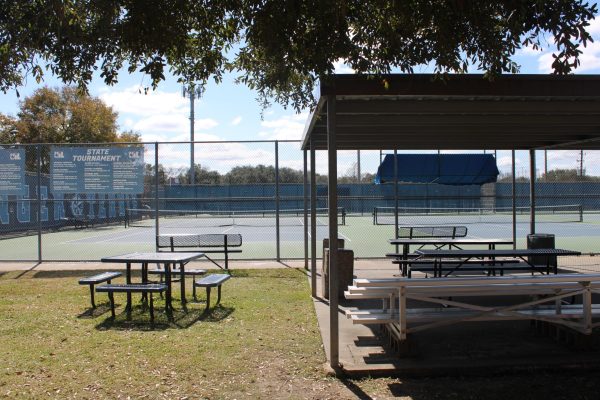
“[We can only play] until the sun goes down,” Head Tennis Coach Brett Bernstein said. “In the fall, sometimes we won’t finish. We just have to call it, basically. This will allow us to complete some of those matches that have been hampered by not having lights at the facility.”
While Clements is typically a host site for regional semifinals, the lack of lights has caused competitions to be shifted so that they start earlier than normal. Assistant Tennis Coach Nicole Kitagawa said that she hopes the new lights and improved bleachers will make the matches more comfortable and convenient for both the audience and the athletes.
“We have some bleachers that are just not formal bleachers, just something we found over the years that we put out there,” Assistant Tennis Coach Nicole Kitagawa said. “To have some official, in-the-ground mounted bleachers, it’s something we’ve never had before.”
The makeshift bleachers were scavenged and paid for by former Tennis Coach John Furlow, Kitagawa said, who was the first tennis coach at Clements. Furlow died in 2020 after coaching tennis for 37 years here. The nice facilities, Kitagawa said, are a testament to Furlow’s resourcefulness over the years.
“The intention is that Clements is going to be the district premier courts that are going to be hosting some tournaments and, hopefully, a regional site,” Kitagawa said. “They’re really doing a good job about giving us an upgrade so that we can bring more schools to Fort Bend.”
The original plan was that the new tennis facility would only contain six courts as opposed to the current eight, but Head Tennis Coach Brett Bernstein said that their proactiveness in the community earned them the two additional courts.
“We host a lot of the middle [schools],” Bernstein said. “So it was important to have a centralized facility that a lot of the schools in Fort Bend could utilize.”
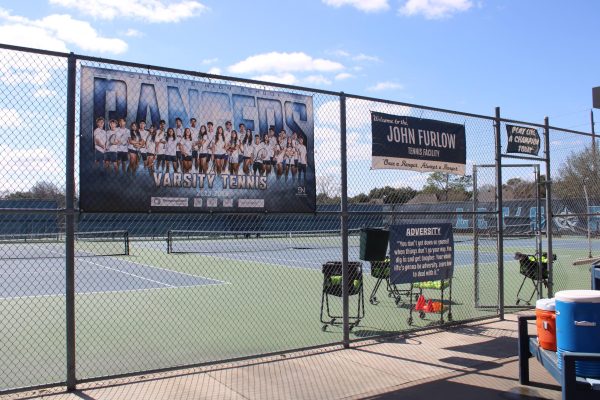
Tennis will be off campus during the 27-28 school year, while the new tennis facilities are constructed. Until then, tennis will continue using their current facilities. In the end, once all of the facilities are finished, every sport will have a place on campus. Some may be temporarily displaced as construction is ongoing, like track has been for the past year now.
“Last year, we originally started off at First Colony, but with them only having a four-lane track, and our track athletes and their track athletes [both practicing], it wasn’t very conducive,” Track Coach Cade Laufer said. “So, probably around this same time last year, higher-ups in the athletic office went ahead and moved us over to Dulles High School for track practice.”
Dulles, which has two eight-lane tracks, provides more than enough space for the track team to practice, Laufer said, with minimal space conflict. Track will most likely remain off campus for another three years, but the only drawback of being off campus so far, Laufer said, is the extra time it takes getting the athletes to Dulles.
“We give our kids the option of getting picked up from Dulles or back here,” Laufer said. “A bus every day brings kids back if it’s easier for them to get picked up at Clements…so there was just working out some of those kinks last year. But other than a little bit of time, it hasn’t been bad at all.”
Time spent traveling between campuses, in the end, is still time that could be better spent elsewhere. Baseball Coach Brett Velliquette considers transportation the toughest part of being off campus but is excited about seeing the new baseball field, which he anticipates will attract new to-be baseball players.
“Well, it’s turf, so that’s nice,” Velliquette said. “It would definitely help with us not going back and forth [from] Frankie. [We’ll get] to spend more time with our families, get more done at practice, be a little more productive.”
Construction:
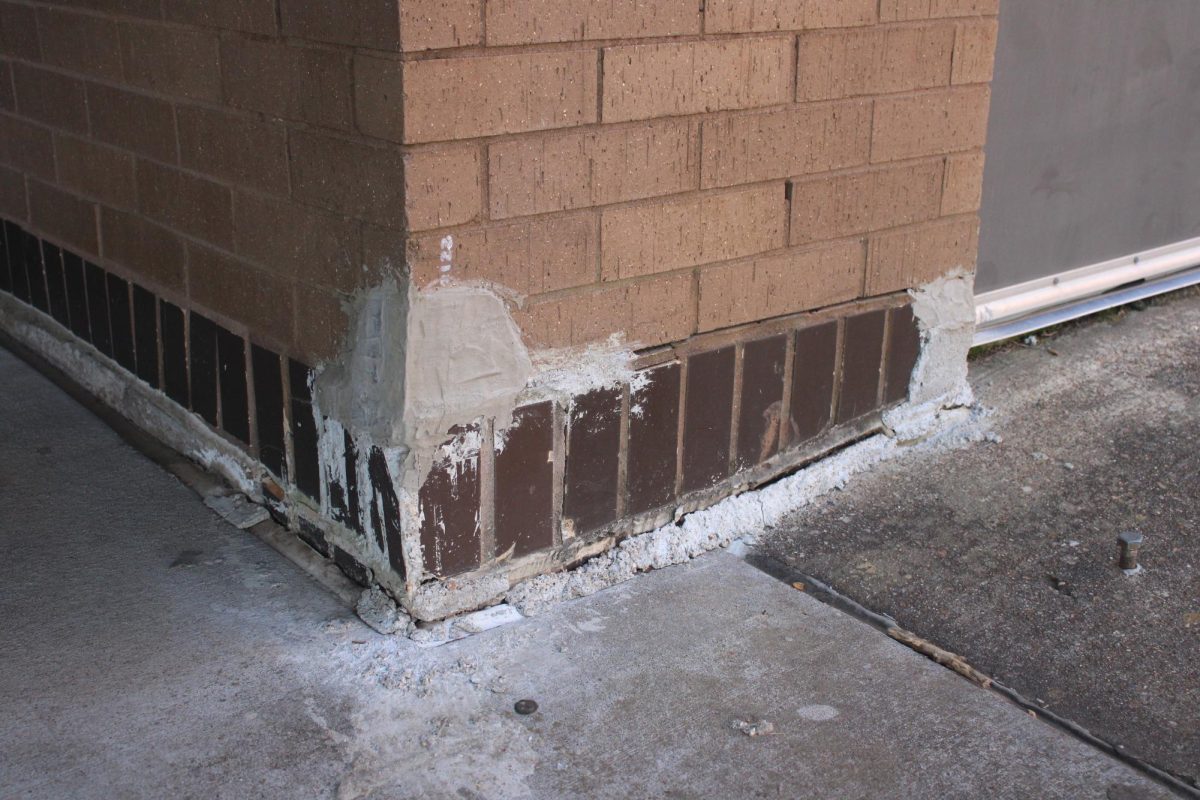
The current campus has various patched-over cracks along the outskirts of the building, flush against the concrete sidewalks and riding up to expose underlying foundation and open space. The worst of it is a jagged, staircase-like fracture that runs almost 30 feet, facing the student parking lot.
To better stabilize the rest of the structure, the new building would sit on concrete piers about 20 feet deep that would act like elephant legs, senior FBISD project manager Guarav Agarwal said.
“Imagine yourself sticking toothpicks into sand deep, deep, deep down, and once they reach a solid base, it forms a step-stable ground,” Agarwal said. “On top of the piers, you connect them with beams all around, and then you pour slab. So then the structural integrity comes into play with that.”
Above ground, steel columns and beams form the exoskeleton. The construction team held a topping ceremony early December to celebrate the placing of the very last steel beam, which Baker attended. She and the other 200 or so attendees all signed the two beams in Sharpie.
“I never thought, as a principal, that I would get to see a new building and get to open it and be part of a ceremony that’s actually a construction company’s tradition,” Baker said. “Just to be a part of that and see a glimpse of their world, it was pretty incredible…I loved being a part of it.”
The roof will be lightweight insulating concrete, and the wall materials will fluctuate depending on the classroom. Most classrooms—except for the science labs, which will have CMU walls—will be surrounded by drywall with a vapor barrier to keep out the moisture. Compared to their drywall counterpart, CMU walls are more expensive to build but also fire and water resistant.
“The codes nowadays are getting more and more stringent, because they’re all geared towards high energy efficiency,” Agarwal said. “[A] building this size 20 years ago could need 600 tons of cooling. Nowadays in 2025, [it] will require 400 tons of cooling, because we are making our envelope more and more efficient with less radiation, less heat.”
Even the window glazing has been adjusted to maximize the amount of natural light coming in, while cutting back on costs and heat. Clerestory windows that allow light and heat in will be installed on the north side, which the sun won’t hit, Agarwal said, while windows on the west and south side will be shaded.
“Machinery comes and goes, depending on which stage of the project you are [on],” Agarwal said. “When it comes to erecting steel, that’s when you have to bring out the big crane. [Otherwise], once the structure is up, most of the time you will not see heavy machinery.”
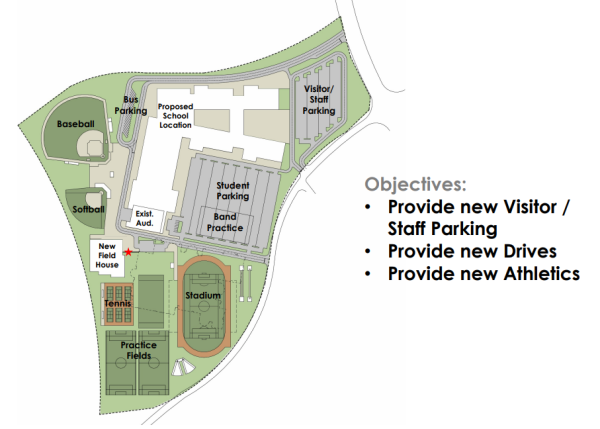
The building is divided into 11 stand-alone building blocks, Agarwal said, which is being constructed in a phased fashion to maximize worker productivity.
“It was never our intention to start all 11 at the same time, because that would mean we have to have 11 concrete crews, 11 steel crews, and that’s just not feasible,” Agarwal said. “By design, they didn’t want to bring more than two crews at the same time on the project, because the site is so tight and it’s costly.”
The two crews start on opposite ends of the building and work clockwise. There are about 300 workers on site every day, but that number could go up to 500 during peak construction season.
“They are working even Saturdays,” Agarwal said. “They were only planning to work five days, but now they’re working six days, over time…we are still committed to [finish and] turn it over in 2027.”
Parking space, however, is limited, even for the workers. Agarwal said they are looking for alternative spaces but are also trying to make peace with what they have.
“City of Sugar Land told us that [the] only place you can access, enter and exit, the site is from Elkins Road,” Agarwal said. “We have a lot of construction vehicles coming in, you have an existing campus that is working…but after so many back and forth, some give and takes, we had to make it work.”
Despite the numerous struggles, Agarwal calls the Clements rebuild his most exciting project yet, and its unique challenges only add to it.
“It involves a melting pot of different stakeholders with the district, with the jurisdiction, and with the campus stakeholders,” Agarwal said. “We have structural engineers, mechanical engineers, electrical engineers, acousticians, theatrical consultants—the list goes on.”
The brunt of the work is executed by the contractor, Durotech, and the architect, the DLR group. The architect designs the building and the contractor manages the execution. Both were decided upon through a request for qualification (RFQ) from the district, ranked and selected based on qualification.
“I can never design a stadium or an auditorium by myself, but I know which people to bring [to] the table to make that happen,” Agarwal said. “There’s whole hundreds of people behind me who make these things happen.”
In November of last year, a portion of engineering students took a guided tour past the construction fence of the new campus. Senior Simon Li said that he found the AC system the most interesting, especially how freon—which circulates a typical residential home—has been swapped out for its less dangerous counterpart, water.
“It’s really cool that all this stuff is the result of our work as engineers,” Li said. “Every single one of those bolts [and] pillars had to be designed and 3D modeled and tested to make sure it fits the correct application for what it needs to be doing…Walking down through the hallway, you don’t think of all the stuff behind the wall.”
Now that Li has had a chance to see the behind-the-scene components that make up the campus, he said he wishes he could stay just to walk the furnished halls of the new campus. Senior Muneeb Ahmed, an aspiring mechanical engineer who also had an opportunity to see the insides of the new campus, said he didn’t realize how massive the campus really was until he was in the midst of it.
“It emphasized to me how many different engineers work together to make something,” Ahmed said. “It’s not just one engineer that makes one product…and the fact that they’re doing all of this right next to us is amazing. They have to accommodate for us being at school the entire time, and they’ve gone so far while doing that.”

For the students that want to leave a permanent, visible mark on the new campus, there is the option to purchase a personalized alumni brick. The $100 4×8 brick offers three lines of custom text, while the $225 8×8 brick offers six lines. Both allow up to 20 characters per line. Baker said that the money from the alumni bricks will fund hand-painted murals for the new campus.
“It’s a great commemorative way to support our alumni, and they can come back and see their brick with their name, their graduation year, and some people have put, like, ‘drum major, 2004,’” Baker said. “It shows pride from our alumni.”
But with the finalization of the new building will come demolition of the current campus.
“There is that emotional tie that you can’t replace,” Baker said. “We can sit here and say how it’s going to be so nice and modern…but there’s still those memories here that are going to be demolished before our eyes.”
Baker, who started working at Clements four years ago but claims it feels more like 20, said that being principal isn’t just a job for her. It’s become a “unity-type situation,” merging her Ranger family here with her family at home.
“It sounds so cliche, but…we need to make the best of the next two years, knowing that this is the last time that anyone will ever be able to walk the halls of this high school,” Baker said. “Don’t take it for granted, even though we do have a bright future in the new school.