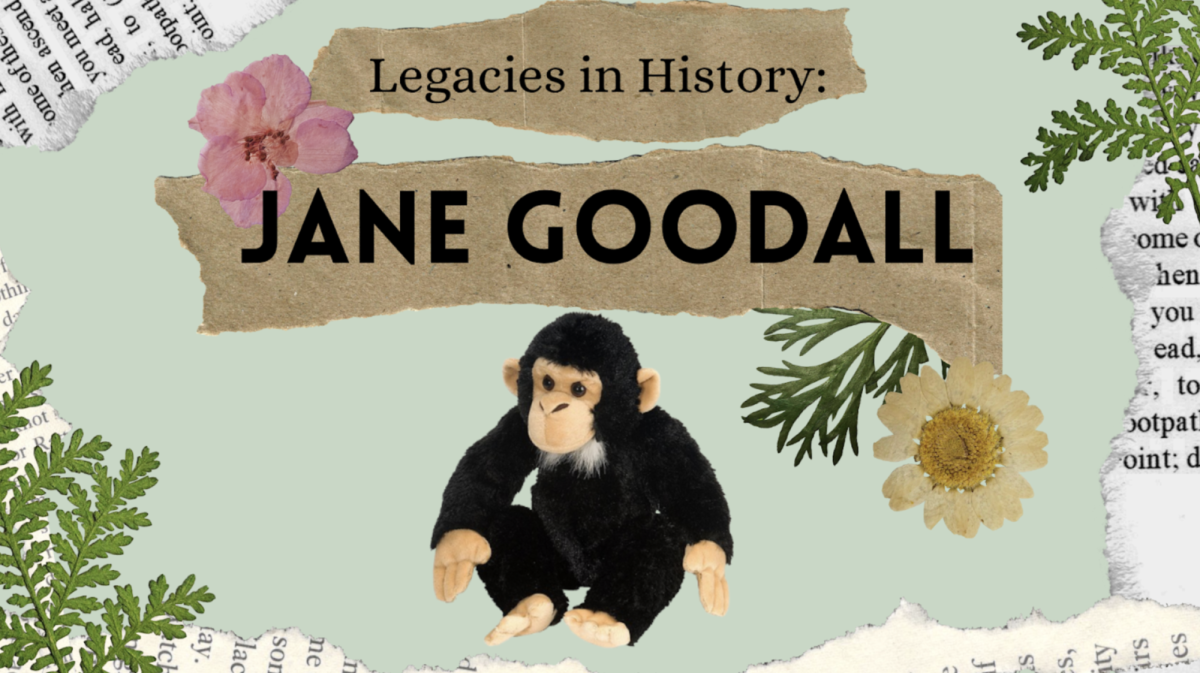
Jane Goodall recently passed away on Oct. 1, and the world applauds her unique and beautiful life’s journey. Activists, politicians, and even Hollywood celebrities remember her impact in primatology, natural science and social activism. But who really was Jane Goodall, and how did she manage to have such a broad global influence?
When she was eight years old, young Jane Goodall read Tarzan and the Dr. Dolittle series, her little mind itching for adventure and the opportunity to work with the animals in her books. Unable to afford college, she studied in secretarial school, an institution teaching basic skills like typing and data entry. However, she never forgot her dream of traveling to Africa and embracing the beauty of nature, saving every penny she earned while working—at the time, she was primarily waitressing and working for a documentary film company. On a trip to Africa, she met Dr. Louis Leakey who offered her a job at the local natural history museum.
Dr. Leakey found Jane Goodall to be the best fit for observing chimpanzees in nature. Uninfluenced by long-term field experience, she could keep an open mind untainted by previous research methods and traditional biases. Additionally she was a woman, and he believed this could not only hinder, but also help her in the field. While most men in his field were not interested in employing patient observation, Jane Goodall had remarkable attention to detail. On the flip side, he gave her the opportunity to observe Chimpanzees, beginning her groundbreaking career. Dr. Leakey explained that women have the ability to absorb crucial details that chimpanzee mothers would in the wild, enabling them to act with empathy and kindness. But Jane Goodall’s legacy teaches us that every human should make the effort to search within themselves for humanity, patience, and consideration. Goodall herself had one of her thumbs bitten off as she was inspecting a chimpanzee at a lab. Instead of hiding it, she proudly displayed it, using her experience to demonstrate to the public both the positives and negatives of captivity on animals.
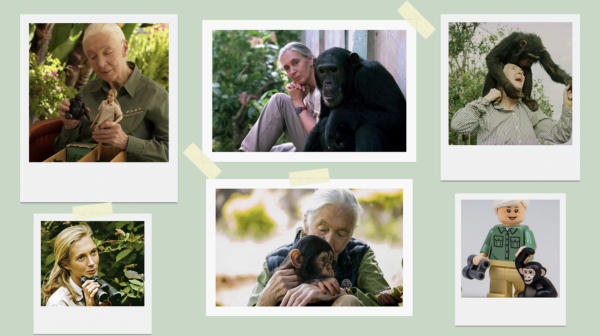
Jane Goodall transforms challenges in her life into the stepping stones of her legacy in natural science and activism, and her influence is seen everywhere. In 2022, both a Barbie doll and a Lego figurine were modeled after her, celebrating her unique journey and accomplishments as a woman unafraid to voice her unorthodox perspective in a male-dominated sector. Several films and books have been created about her, focusing not only on her curiosity as a primatologist but also on her immense courage, battling poaching and illegal wildlife trafficking. She became a United Nations messenger of peace, taking on her role through activism for environmental preservation and sustainable human development.
After Jane Goodall’s passing on Oct. 1, her son stated that “to the world, she was Dr. Jane Goodall—to me, she was simply my mother.” He honored his mother by underscoring what was most important to her: commitment to humanity and compassion, not the towering accomplishments that the media often focuses on. This raises a question: Do we remember leaders like Jane Goodall by who they truly were or who they would like to be remembered as?
Perhaps the answer is not so complicated. The legacies of heroes that we immortalize are best remembered through their material accomplishments, what they did and not who they were. But observers looking to the past to find both lessons and inspiration would find that our leaders’ actions often speak for exactly who they were.